

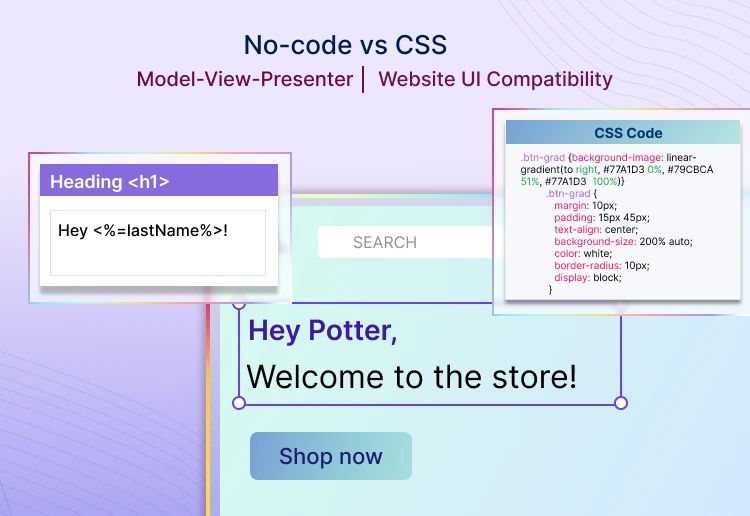



Business owners nowadays prefer the hassle-free option of no-code platforms for website interface management. You can receive faster and affordable user interface development options with no-code platforms over CSS.
However, developing a custom user interface for your audiences requires precise CSS coding and knowledge of developers. CSS introduces uniqueness to your website, necessary for sustaining users in a competitive business landscape. CSS coding is effective for maintaining your large and evolving website.
This blog evaluates CSS vs no-code platforms’ effectiveness in custom UI management of your website. This blog showcases a direct comparison based on the user perspective and analyzes the best solution for your website UI.
Trends of Using No-code or Low-Code Platforms
You can use a wide range of no-code platforms for website interface management nowadays. Availability of these platforms influences entrepreneurs to select no-code platforms during the ❝no-code vs coding❞ decision.
➯ Squarespace
➯ Webflow
➯ Bubble
➯ Adalo
These👆 are quality options for template and feature-rich web application creation. These pre-developed platforms provide people with an easy option to manage their website and application interface.
These platforms provide entrepreneurs with an easy option for website management without coding knowledge. You can receive the assistance of available templates to introduce a Model-View-Presenter (MVP) architecture for your website with no-code platforms. Such a benefit can make website building and UI management five times more efficient and affordable.
Some No-Code Apps for Unique Website UI
There are many no-code apps in the current market, suitable for your desktop and mobile website UI management.
- Webflow assists you in introducing high-end design control
- Bubble is a pre-developed solution for your complex web app design tasks
- Adalo is a suitable mobile-centric UI design platform; it is considered a “mobile-first design” app.
- Apps like Durable and Tilba are suitable for crafting a user-friendly website for your business.
The usability of these apps influences entrepreneurs to avoid CSS over a no-code option at times, managing UIs.
No-code/Low-code vs Custom CSS
There are a few major differences between a dedicated CSS and a no-code solution for website UI management. Skills, control, use case (scenario), and cost are important factors that create a difference between CSS vs No-code platforms in website UI management.
| No-Code | CSS | |
|---|---|---|
| Necessary skills | User-friendly interface, it requires no specific coding knowledge for work. | CSS syntax and web development principles are the key knowledge necessary for CSS. |
| Efficiency | ❝Drag❞ and ❝drop❞ features, pre-built templates make website UI management easier with No-code platforms. | CSS development process is slower. Each styling and design element needs to be manually written using code. |
| Control and flexibility | Controls are limited as the no-code platforms feature existing templates and design options. | CSS comes with specific control over color, typography, layouts, and other details. Custom design introduction for your webpage becomes easier with CSS. |
| Cost | Some of the no-code platforms come with subscription-based models. It is affordable compared to CSS. | Cost increases in CSS implementation as you have to hire developers. Specific coding also takes valuable time in business. |
| Use Case | No-code tools are effective for simple website interfaces, prototyping, and internal business tools. | Complex and custom website design becomes easier with CSS. You can introduce the uniqueness of your brand through custom UIs. Apart from that, advanced features and design freedom are a bonus of CSS. |
| Maintenance | No-code platforms manage security, maintenance, and updates on their own. Making the overall process of maintenance simple. | CSS needs manual updates and bug fixing. You need a skilled developer to maintain its complex codebase. |
The table high light difference between no-code vs coding in the case of your website UI management and maintenance process. Tasks like simple website design and prototyping can be solved easily by no-code platforms. Whereas any major upgrade in design or adding specific UIs requires CSS skills.
Notable Limitations in Your No-code Platforms
No-code platforms are most effective at times of testing and prototyping websites and website UIs. Online brand introduction at the beginning of business is generally managed by the founders through no-code options. Redesigning the overall presentation of applications and websites with an aim of providing the user a new interface is managed through CSS over no-code platforms.

No-code apps also do not promise AI and ML integration in the interface design process. You need to introduce AR and VR options on your website for proper user attraction. 🚫 No-code platforms do not support any kind of AR/VR tools, limiting their applicability. Complex UI measurements for your website need CSS knowledge.
Final Decision on CSS vs No-code
On-demand customization of your website UI is possible through a quality programming language like CSS. Choosing CSS over no-code platforms can ensure your website’s long-term performance and maintainability.
No-code tools application provides an easy solution to UI management; however, it also restricts your capabilities among its built-in features. Limited design capability can restrict your brand’s online presentation, which can be custom-managed through CSS. In the duel of no-code vs coding, detailed coding through CSS can help to highlight each functionality of your brand.
🚀 A correct and efficient coding process via CSS boosts the speed and loading time of your page.
Factors like debugging and synchronizing large image and video files are only possible through precise coding. CSS also provides you with an option for future modification of UI on the website according to the needs of the market. Thus, if you are looking for custom UI management and better authority over a quality website for your brand, the selection of CSS over no-code platforms is your choice.